
We use cookies on this site to enhance your experience.
By selecting “Accept” and continuing to use this website, you consent to the use of cookies.
Part 1: Group Level Assessment (GLA)
The Group Level Assessment (GLA) is the first part of the Youth4CJ project. Group Level Assessment (GLA) is a participatory qualitative methodology that brings together large groups of participants to identify issues, collaboratively analyze emerging themes, and develop collective action and solution ideas through a structured seven-step process (Vaughn, 2024; Vaughn & Lohmueller, 2014).
As the first part of the Youth4CJ project, participatory workshops using the GLA were conducted between January and March 2026 in each participating country, with two GLAs held in South Africa. These workshops engaged approximately 138-145 youth who were involved in, or interested in, climate action or activism. Together, participants identified key challenges and barriers facing these youth in their local contexts, collaboratively analyzed the most prominent themes, and generated potential actions and solutions. While many challenges were shared across countries, participants also identified issues unique to their local political, social and environmental context, The actions and solutions developed during the GLAs provide the foundation for the Youth Participatory Action Research (yPAR) projects in Part 2 of Youth4CJ.
Across countries, several common themes emerged:
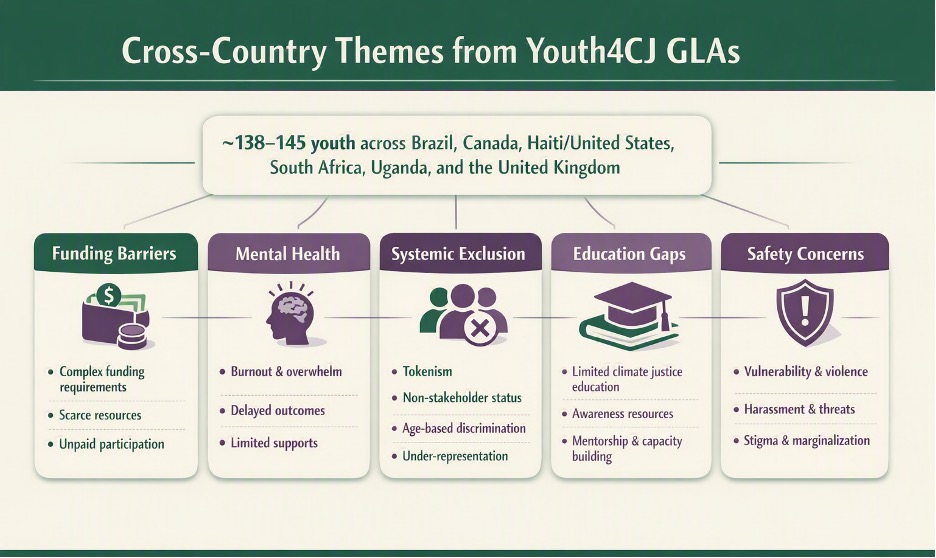
The following sections present the participatory workshop process and key findings from each participating country.
The GLA in Brazil was done on two online sessions, and it gathered 21 youth from the 5 regions of Brazil (North, Northeast, West-Central, Southeast and South), from different organizations, collectives, individual activists, or youth who wants to join the climate activism. The discussion started on the challenges to be an activist from the daily life burden, mental health, support network, and space for political action, there were also critical about the government, the market, universities and structural aspects. They also discussed a lot about the importance of traditional communities to protect the ecosystems and environmental justice on who are the most affected by Climate Change, and they were also worried about fake news and political conflicts. In general, the participants were very engaged, although expressing frustration, anxiety, indignation, and discouragement. The most voted themes to be the center of discussion were mental health, vulnerability and violence, climate justice and environmental racism, daily challenges, youth voice in decision-making and public policies, body-territory and territorialities. Among these themes it was voted that the final discussion would be on climate justice and environmental racism, youth voice in decision-making and public policies, and body-territory and territorialities. From this discussion emerged proposals on the necessity to recognize and support the traditional communities and its knowledge, the youth should have space in the participatory and decision-making spaces, invest on Nature Based Solutions, supporting local actions based on the NDCs, and focusing on the ecosystem restoration. The ideas are in the following suggestions:
The Canadian GLA engaged 26 youth from across the country in three online workshop sessions. Many participants identified as persons with disabilities, and the group was diverse in terms of age, climate action experience, ethnicity, ability, and geographic location, with participants representing communities from the East Coast to the West Coast of Canada. Participants joined the workshops for a variety of reasons, including a desire to connect with like-minded peers, be part of a supportive community, contribute to meaningful research, support other youth, and engage in action-oriented climate work.
Participants identified numerous barriers to youth climate action, including economic constraints, limited opportunities for meaningful engagement, inadequate climate education, insufficient mental health supports, and feeling unheard or tokenized by decision-makers. Many described feeling overwhelmed by the scale and urgency of the climate crisis and frustrated by the slow pace of systemic change. Their discussions also highlighted broader themes related to balancing climate activism with other life priorities, intergenerational justice, advocacy, access to resources, and pathways to climate-related careers. Participants further recognized the influence of capitalism and unequal power distribution in shaping climate injustice and limiting opportunities for meaningful youth participation.
Participants proposed several actions to strengthen youth climate engagement, including expanding career guidance and mentorship in climate-related fields, creating paid and accessible opportunities for youth participation, fostering community dialogue on climate change, addressing financial barriers to involvement, and ensuring that climate initiatives are inclusive and accessible for marginalized youth. They also emphasized the importance of advocacy and meaningful intergenerational collaboration to ensure youth voices are genuinely reflected in climate decision-making. Based on these findings, the Canadian yPAR project will focus on increasing awareness of climate action resources and climate-related career opportunities for youth with disabilities, with the goal of improving accessibility, strengthening participation, and supporting more inclusive pathways into climate action.
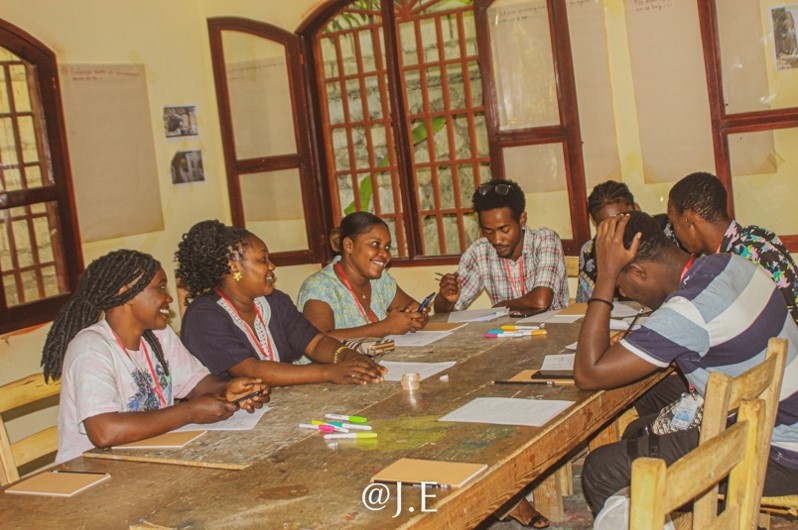
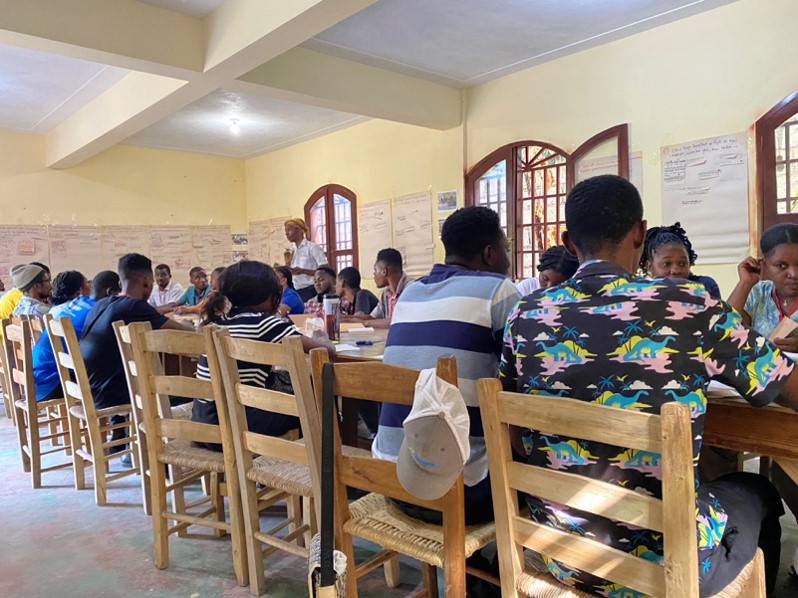
The Group Level Assessment (GLA) event in Jacmel, Haiti brought together 25 Haitian youth through a collaborative partnership between the community-based organization Jakmel Ekspresyon and university partners from the University of Cincinnati, Cal Poly Pomona, and Colorado State University. GLA was intended to identify the challenges young people face in engaging with climate action as well as to create a participatory space for collective reflection, shared meaning-making, and action planning. Through facilitated discussions and interactive activities, participants articulated how climate vulnerability in Haiti is inseparable from broader structural issues, including youth disempowerment, political instability, economic hardship, and limited institutional support. Young Haitians described feeling excluded from formal decision-making processes and emphasized that a lack of accessible, widespread understanding of the climate crisis further hinders meaningful engagement. Limited resources—both material and educational—were also identified as significant barriers to sustained climate action. Despite these challenges, the GLA process revealed a strong sense of agency and commitment among participants. Youth highlighted the importance of community-based education initiatives, peer-to-peer learning, and collective action as critical pathways forward. They emphasized the value of mutual support networks and locally-grounded strategies that build resilience in ways that are responsive to their lived realities. Initial action ideas emphasized creative, arts-based methods (e.g., theatre) as powerful tools to raise awareness about the climate crisis, spark dialogue, and engage the wider community.
The South African team conducted two GLAs. The first GLA was an online workshop with She4Earth, an organisation focusing on African youth climate education and advocacy. Participants engaged enthusiastically despite the challenges with the online environment. Participants prioritised the following three themes: climate education, mentorship and capacity building, and finance and fundraising. The second GLA was with the African Reclaimers Organisation. The GLA was held in person. Participants highlighted the following three themes: Education and advocacy, recognition and transport. Both groups recognised education and advocacy as a priority. The South African team, in collaboration with the youth partners, will build on education and advocacy in the yPAR phase.
The GLA in Uganda was held in person Fridy, March 13th with 22-26 youth. The participants identified four key challenges (common emerging themes) shaping climate action and activism. These included; limited funding, knowledge gaps, weak or unclear policies, and systemic barriers. Across discussions, these issues were reinforced by concerns about inadequate government support, restrictive funding requirements, exclusion of certain group, and the mental health strain associated with sustained activism.
To address these challenges, participants proposed practical and collaborative solutions. These include improving access to funding by easing eligibility criteria, increasing government support, strengthening climate education and awareness at community level, and reforming policies to ensure clarity, relevance, and effective implementation. Emphasis was also placed on building strong partnerships among youth groups, government institutions, and local communities. Lastly, the youth also highlighted a need for inclusivity, mentorship, and collective action to better equip and empower young people to lead impactful and sustainable climate initiatives.
Read Uganda’s GLA report.
In a partnership involving researchers from the University of Sussex, the Institute of Social Justice, York St John University, and staff from the Ubele Initiative, in the UK the participatory workshop took place on the 1st of March, 2026 and involved 18 Black and racialised young people aged 18-35. Hosted by the Ubele Initiative at the Wolves Lane Centre in London, the workshop provided a space to discuss climate justice in a friendly and welcoming setting. Climate change was discussed as a complex issue that intersects with other societal issues such as poverty, capitalism, race, and power. Participants identified a need for more climate education focused on climate justice (rather than on climate change “only”) as well as for more mentorship, capacity building, and inclusive programmes focusing on empowering youth. Importantly, young people also discussed the importance of including their voices in climate politics. The lack of diversity and representation in the climate space was systematically discussed as a barrier to climate action and activism. Financial resources and career opportunities were also discussed as lacking, despite being seen as key conditions for sustained engagement with climate action over time. If you would like to learn more about the concerns and issues discussed during the workshop, please check our report:
Fernandes-Jesus, M., Chhabra, S., Oredeko, C., Ahmed, A., Heinemeyer, C., Parks, J., & Adekola, O. (2026). Perspectives on the need and challenges of empowering Black and racialised youth for climate justice: Findings from a participatory workshop in the UK. Youth4CJ project, national report.
Contact Us
E: veris@wlu.ca
Office Location:
232 King St. N., Waterloo, ON, N2G 4V6
We are currently working remotely.